LAS BAULAS NATIONAL MARINE PARK
The Leatherback Turtles of Playa Grande
For millions of years, the largest turtles on Earth have crossed the Pacific to lay their eggs on this beach. Seeing one is a night you never forget.
Photo: NOAA (public domain)
Playa Grande is one of the most important nesting beaches in the world for the Pacific leatherback, a critically endangered sea turtle. The whole beach is protected as part of Las Baulas National Marine Park (baula is Spanish for leatherback), and the people who live here have spent decades making sure it stays wild, dark, and quiet for them.
Meet the leatherback
2 m
The largest turtle alive
Adults can grow over 2 meters (6.5 ft) long and weigh more than 500 kilos (1,100 lb).
100M+
Ancient survivors
Leatherbacks belong to a lineage that has survived for over 100 million years.
1,000 m
Deep divers
They can dive deeper than 1,000 meters (3,300 ft) hunting jellyfish, their main food.
90%
Critically endangered
Eastern Pacific leatherbacks have declined by more than 90% since the 1980s. Every nest counts.
A night on the beach
What happens when a leatherback comes ashore.
She comes ashore
Under cover of darkness, a female hauls herself up the beach, often around high tide, looking for the perfect spot above the waterline.
She digs and lays
Using her back flippers, she digs a deep nest and lays around 80 eggs, the size of billiard balls. The whole process can take one to two hours.
She returns to the sea
She covers the nest, disguises it with sand, and heads back to the ocean. She may return to nest several times in one season, about every 9 to 10 days.
The eggs incubate
For about two months, the eggs incubate in the warm sand. The sand temperature decides the sex: warmer nests produce more females.
The hatchlings emerge
The hatchlings dig out together, usually at night, and race toward the brightest horizon, which should be the moonlit sea.
Decades later
Only a tiny fraction survive to adulthood. The females that do will return, years later, to nest on the very same coastline.
Seeing them: turtle season and tours
When: leatherbacks nest on Playa Grande roughly from October to March, with the peak usually November through February.
How: at night, the beach is only open on official guided tours with park rangers. Ask where you’re staying, or visit the Las Baulas ranger station next to Hotel Las Tortugas to book.
What to expect: spots are limited each night, and you may wait a while before rangers call your group down to the beach. Sightings are never guaranteed, since these are wild animals. When it happens, it’s unforgettable.
Bring: dark clothing, closed shoes, insect repellent, water, and patience.
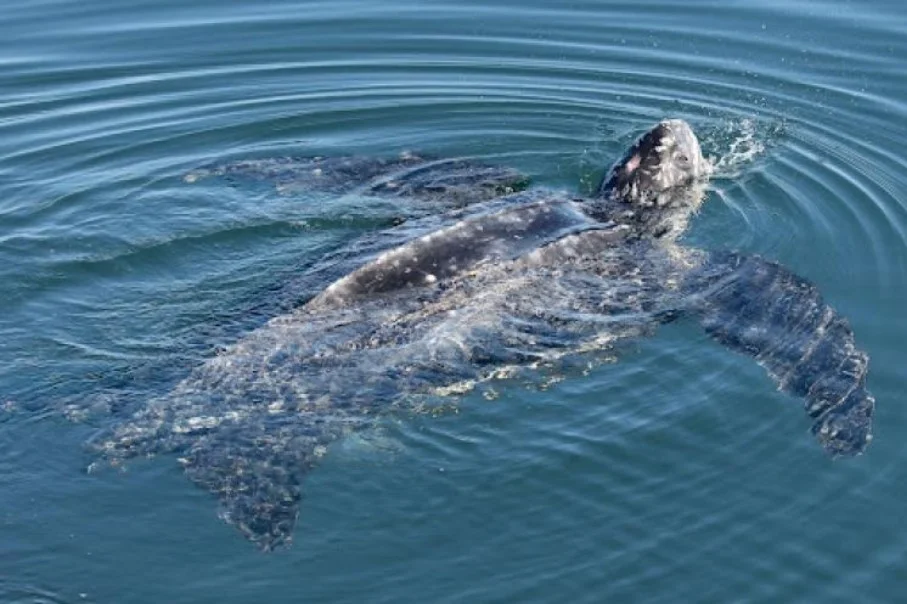
Photo: NOAA Fisheries (public domain)
The rules on the beach
No lights. No flashlights, phone screens, or flash photography on the sand at night. Light confuses nesting females and hatchlings.
Stay with your guide. Rangers decide when and how close you can get. Follow them at all times.
Dress dark and stay quiet. Dark clothing and low voices keep the turtles calm.
Never touch. Don’t touch turtles, eggs, or hatchlings, and never pick up a hatchling to help it to the sea.
Respect the night closure. During nesting season the beach is closed to the public at night, except on guided tours.
How you can help
Keep it dark. If you’re staying near the beach, close curtains at night and switch off outdoor lights that face the sand. Hatchlings follow light, and artificial light can lead them inland instead of to the sea.
Leave nothing behind. Leatherbacks mistake plastic bags for jellyfish. Pack out all your trash, and pick up any plastic you see.
Watch your step. Nests aren’t always marked. Avoid digging deep holes or driving anything on the sand.
Support the research. Scientists have studied leatherbacks at Playa Grande for decades. You can learn more about their work and how to support it at The Leatherback Trust.
A community that chose the turtles
Decades ago, Playa Grande could have gone the way of other Guanacaste beach towns. Instead, local residents, conservationists, and researchers pushed to protect the nesting beach, and Las Baulas was created in 1991. That choice is why Playa Grande still has no buildings on the sand, dark nights, and a quiet, natural feel today.